Reconstitution — dissolving a lyophilized peptide in solvent to produce a working solution of known concentration — is one of the most common procedures in peptide research, and one of the most error-prone. Miscalculating the reconstitution volume directly introduces dose error into every downstream experiment. This guide walks through the full calculation framework, including how to correctly account for peptide content when the powder contains water and counterion mass.
Research use only. All examples and procedures below are written for in vitro assays and preclinical animal research conducted by qualified investigators. This guide is not medical advice, is not a protocol for human administration, and does not describe approved therapeutic products or dosing.
The Core Formula
The fundamental relationship is:
Volume of solvent = Mass of peptide ÷ Desired concentration
For example, to reconstitute 5 mg of peptide to 5 mg/mL:
5 mg ÷ 5 mg/mL = 1 mL of solvent
Simple in principle — but in practice, "5 mg of peptide" is rarely 5 mg of pure peptide. Lyophilized powder typically contains residual water plus counterion salt, which means the vial's labeled mass overstates the actual peptide present. This is where the peptide content value from the Certificate of Analysis becomes critical.
Gross Mass vs. Net Peptide Mass
Two distinct values appear in reconstitution calculations:
- Gross mass — the labeled mass on the vial (e.g., "10 mg")
- Net peptide mass — the actual peptide content after subtracting water and counterion
Net peptide mass = Gross mass × Peptide content %
From the COA, peptide content is calculated as:
Peptide content = 100% − (water content + counterion content + residual solvents)
Worked Example
A vial labeled "10 mg" with:
- 6% water
- 9% acetate counterion
- 0.2% residual solvents
Peptide content = 100 − (6 + 9 + 0.2) = 84.8% Net peptide = 10 mg × 0.848 = 8.48 mg actual peptide
If your experiment requires 1 mg/mL of actual peptide, you would reconstitute this vial in 8.48 mL — not 10 mL.
Two Calculation Scenarios
Researchers typically work in one of two modes:
Scenario A: "I have X mg. I want Y mg/mL. How much solvent?"
Solvent volume (mL) = Net peptide mass (mg) ÷ Desired concentration (mg/mL)
Example: 10 mg vial at 84.8% peptide content, target 2 mg/mL.
- Net peptide = 10 × 0.848 = 8.48 mg
- Solvent volume = 8.48 ÷ 2 = 4.24 mL
Scenario B: "I want to deliver X µg per Y µL. How do I prepare?"
Common in preclinical small-animal research where injection volume per animal is fixed by protocol.
Required concentration (mg/mL) = Target dose (µg) ÷ Injection volume (µL)
Example (rodent research): Protocol specifies 100 µg per 100 µL per animal.
- Required concentration = 100 µg ÷ 100 µL = 1 µg/µL = 1 mg/mL
- For a 10 mg vial at 84.8% peptide content (8.48 mg net), solvent volume = 8.48 mL
Unit Conversion Reference
Reconstitution math involves frequent unit conversion. Common conversions:
| From | To | Factor |
|---|---|---|
| 1 mg | 1000 µg | ×1000 |
| 1 µg | 1000 ng | ×1000 |
| 1 mL | 1000 µL | ×1000 |
| 1 mg/mL | 1 µg/µL | equivalent |
| 1 mg/mL | 1000 µg/mL | ×1000 |
Quick tip: 1 mg/mL = 1 µg/µL. Many dosing calculations collapse when you hold this equivalence in mind.
Choosing the Reconstitution Solvent
The COA and storage & reconstitution guide specify the appropriate solvent. Common options:
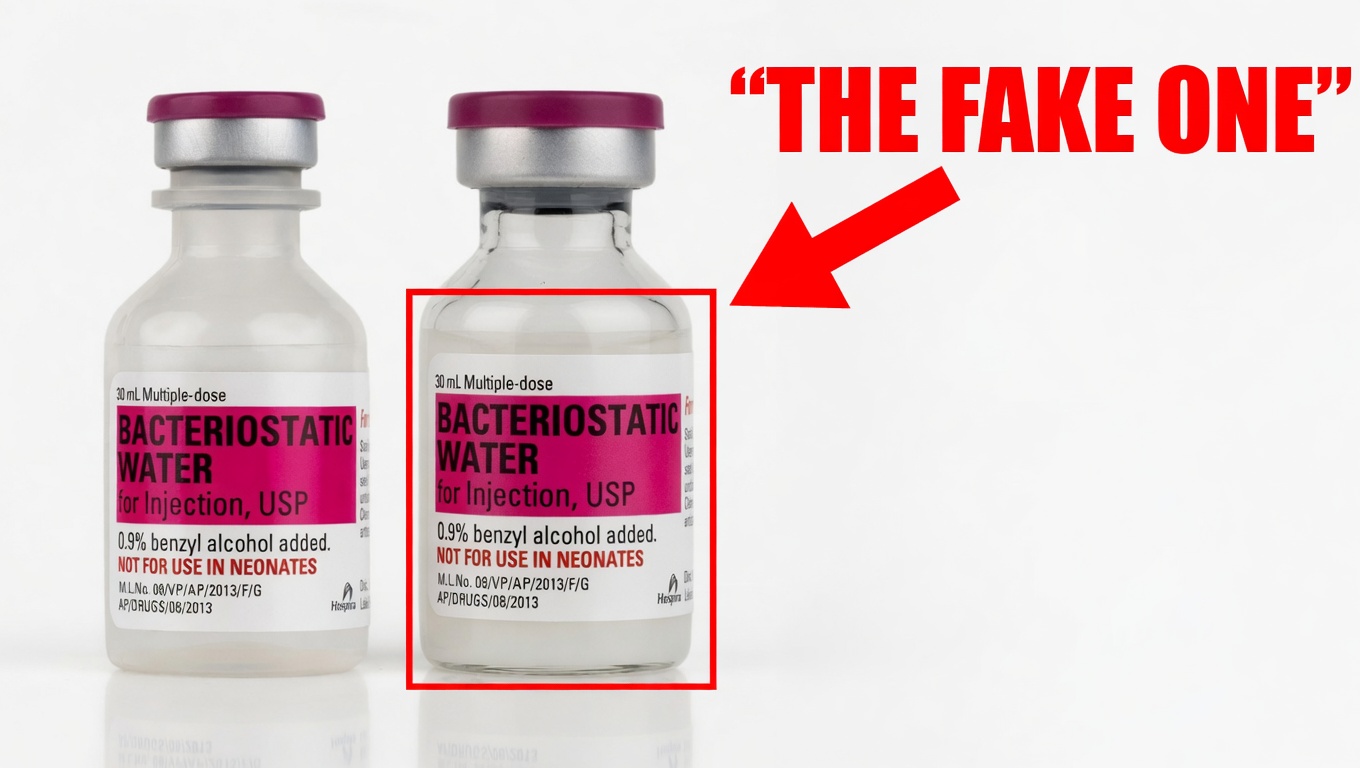
- Bacteriostatic water (BAC water) — 0.9% benzyl alcohol preservative; standard for peptides used in multi-dose research studies where the vial will be accessed repeatedly
- Sterile water for injection (SWFI) — no preservative; for single-use or short-duration work
- Dilute acetic acid (0.1–1%) — for peptides with limited aqueous solubility
- DMSO — for highly hydrophobic peptides; dilute into aqueous buffer before use
Important: The solvent becomes part of the final formulation. Using BAC water when a peptide is incompatible with benzyl alcohol (some hydrophobic analogs) can degrade or precipitate the compound.
Choosing a Working Concentration
Higher concentrations mean smaller administration volumes and longer vial life, but also:
- Reduced stability for some peptides — certain peptides aggregate at high concentration
- Less tolerance for pipetting error — small volume errors become large dose errors
- Precipitation risk — exceeding solubility limits produces a cloudy solution with unknown actual concentration
Practical guidance:
- 1–5 mg/mL is a common range for most research peptides
- GLP-1 class and fatty-acid-conjugated peptides (semaglutide, tirzepatide, retatrutide) tolerate higher concentrations due to albumin-binding architecture, but gentle handling is essential
- If your peptide appears cloudy after reconstitution, concentration is likely too high — dilute with additional solvent and gently invert
Step-by-Step Reconstitution Procedure
- Review the COA. Confirm lot number, peptide content, recommended solvent.
- Equilibrate the vial to room temperature. Reconstituting a cold vial causes condensation on the stopper.
- Calculate net peptide mass. Gross mass × peptide content % from the COA.
- Calculate solvent volume. Net peptide mass ÷ desired concentration.
- Draw the calculated solvent volume into a sterile syringe.
- Inject the solvent down the inner vial wall, slowly. Do not inject directly into the powder — this causes foaming and shear stress on the peptide.
- Gently swirl or invert. Do not shake. Amphiphilic peptides (including all fatty-acid-conjugated GLP-1 analogs) foam and denature with vigorous agitation.
- Allow to fully dissolve before use. Typically 30 seconds to a few minutes. The solution should be clear.
- Label the vial with date of reconstitution, concentration, and initials.
- Store at 2–8°C, protected from light.
Worked Example: Full Calculation
Scenario: A preclinical rodent research protocol calls for 250 µg per 100 µL injection volume per animal. You have a 5 mg vial of the research peptide. The COA reports:
- HPLC purity: 98.4%
- Water content: 4.8%
- Acetate content: 7.2%
- Residual solvents: 0.3%
Target working solution: 2.5 mg/mL of actual peptide.
Step 1 — Verify target concentration matches administration format:
- 250 µg / 100 µL = 2.5 µg/µL = 2.5 mg/mL ✓
Step 2 — Calculate peptide content:
- 100 − (4.8 + 7.2 + 0.3) = 87.7%
Step 3 — Calculate net peptide mass:
- 5 mg × 0.877 = 4.385 mg actual peptide
Step 4 — Calculate solvent volume:
- 4.385 mg ÷ 2.5 mg/mL = 1.754 mL solvent
Step 5 — Round appropriately:
- Add 1.75 mL bacteriostatic water.
- Final actual concentration: 4.385 mg ÷ 1.75 mL ≈ 2.506 mg/mL
Each 100 µL research volume now delivers approximately 250.6 µg of actual peptide to the target animal or in vitro preparation.
Common Mistakes
- Using gross mass instead of net peptide mass. The most common error. Produces 10–20% systematic overdosing if peptide content is ~85%.
- Ignoring water content alone. Some researchers subtract counterion but not water (or vice versa). Both must be subtracted.
- Shaking the vial. Denatures amphiphilic peptides and introduces foam that can trap peptide at the air-liquid interface.
- Using the wrong solvent. BAC water with an incompatible peptide causes degradation.
- Not equilibrating to room temperature first. Condensation affects the effective volume.
- Recording concentration without the date. Reconstituted peptide stability is limited; undated vials are unusable for rigorous work.
- Assuming every lot is identical. Peptide content varies batch to batch — recalculate for every new lot.
Summary
Accurate reconstitution is the foundation of reproducible peptide research. The math itself is simple — mass divided by concentration — but arriving at the correct mass requires reading the COA properly and accounting for water and counterion content. Gross mass is almost never the right input. Net peptide mass, derived from the batch-specific peptide content on the COA, is. Combining careful calculation with gentle reconstitution technique produces solutions of known concentration that behave as intended across downstream experiments.
Gross mass is almost never the right input. Net peptide mass, derived from the batch-specific peptide content on the COA, is.
All information presented is based on published analytical chemistry literature and standard laboratory peptide handling practice. Products referenced are sold for laboratory and research use only, are not for human or veterinary use, and are not intended to diagnose, treat, cure, or prevent any disease. This article is not medical advice.
Disclaimer: This article is provided for educational and informational purposes only. All products referenced are intended strictly for laboratory and research use.