Counterfeit Bacteriostatic Water: How the Wrong Diluent Contaminates Research Peptides
The diluent used to reconstitute a lyophilized peptide is not an afterthought — it is part of the experimental system. A high-purity peptide reconstituted in an off-spec or counterfeit bacteriostatic water (BAC water) is no longer a high-purity sample. This guide explains why diluent quality matters, how to identify suspect BAC water, and what visual and chemical signs indicate a contaminated reconstitution.
All discussion in this article refers to laboratory and research-use-only workflows. Nothing here describes preparation for human or veterinary administration.
What "Bacteriostatic Water" Actually Is
USP-grade bacteriostatic water for injection is sterile water containing 0.9% benzyl alcohol as a bacteriostatic preservative. In the United States, the dominant manufacturer is Hospira (a Pfizer company), which produces it under cGMP conditions with documented:
- Sterility and endotoxin testing (USP <71>, <85>)
- Particulate matter limits (USP <788>)
- pH specification (typically 4.5–7.0)
- Tamper-evident packaging with visible lot/NDC markings and a flip-off cap printed with the manufacturer name
The benzyl alcohol does not sterilize the water — it suppresses microbial growth in a previously sterile, sealed vial that is punctured repeatedly during multi-use reconstitution. Without that preservative, or without the underlying sterility and particulate control, the "water" is just an uncharacterized solvent.
Why Counterfeit and Off-Spec BAC Water Exists
Genuine USP bacteriostatic water is inexpensive at the manufacturer level but supply is periodically constrained. That gap is filled by:
- Repackaged or relabeled product of unknown origin
- "Bacteriostatic-style" water compounded by unlicensed sellers — typically tap or RO water with benzyl alcohol added by hand
- Counterfeit vials printed with cloned Hospira labeling but containing unverified contents
- Expired or improperly stored authentic product re-marketed as fresh
For a research lab, the consequence is the same regardless of intent: the diluent is no longer a controlled variable.
How the Wrong Diluent Contaminates a Peptide Sample
A lyophilized peptide is dry, stable, and inert. The moment it contacts a liquid, the chemistry of that liquid becomes the chemistry of the sample. Several distinct failure modes can result.
1. Microbial Contamination
Without a validated bacteriostatic agent at the correct concentration, microorganisms introduced from the air, the vial stopper, or the syringe will proliferate over the typical 3–4 week refrigerated working window.
- Bacterial growth produces proteases that cleave the peptide backbone, lowering effective concentration and generating fragment impurities.
- Metabolic byproducts shift pH, which accelerates deamidation at Asn and Gln residues.
- Endotoxin (lipopolysaccharide) released by Gram-negative bacteria is heat-stable and will persist in the sample even if the organisms themselves die.
2. Particulate Contamination
Counterfeit and homemade BAC water frequently fails USP <788> particulate limits. Particulates seed peptide aggregation:
- Hydrophobic particles act as nucleation sites where peptide molecules cluster and precipitate.
- Once aggregation begins, it is autocatalytic — soluble peptide is consumed by the growing aggregate.
- The visible result is cloudiness, haze, or floating fibers in a solution that should be water-clear.
3. Chemical Incompatibility
Genuine USP bacteriostatic water is buffered within a tight pH window and is free of trace metals. Off-spec product is not:
- Trace iron, copper, or manganese catalyze oxidation of Met, Cys, Trp, and Tyr residues.
- Out-of-spec pH (too acidic or too alkaline) accelerates hydrolysis of Asp-Pro and Asp-Gly bonds.
- Chlorine residuals from inadequately purified source water react with aromatic side chains.
4. Wrong Preservative or Wrong Concentration
Some counterfeit products substitute or under-dose the benzyl alcohol:
- Too little benzyl alcohol (below ~0.9%) fails to suppress microbial growth.
- Too much benzyl alcohol or substitution with other alcohols (ethanol, isopropanol) can directly denature the peptide, especially peptides with significant secondary structure.
- Non-benzyl preservatives (methylparaben, phenol) interact differently with peptide side chains and are not interchangeable.
The Cloudiness Signal
A correctly reconstituted research peptide in genuine bacteriostatic water should be optically clear within seconds to a few minutes of gentle swirling. Cloudiness — whether it appears immediately or develops over hours to days in storage — is a high-confidence indicator that something has gone wrong.
| Visual Observation | Likely Cause |
|---|---|
| Cloudy immediately on reconstitution | Particulates in diluent, peptide-diluent pH incompatibility, or rapid aggregation triggered by contaminants |
| Clear at first, cloudy after 24–72 hours | Microbial growth (insufficient or absent preservative), slow aggregation seeded by trace particulates |
| Stringy fibers or visible flakes | Advanced aggregation; sample is no longer suitable for quantitative work |
| Yellow or amber tint | Oxidation of aromatic residues, often catalyzed by trace metals in off-spec diluent |
| Persistent foam after gentle swirling | Possible surfactant contamination in the diluent |
Cloudiness is not always reversible. Aggregated peptide does not return to solution by warming or by additional dilution, and any concentration measurement on a cloudy sample is unreliable.
How to Verify Your Bacteriostatic Water
Before reconstituting valuable research material, inspect the diluent vial against the genuine product profile.
Packaging Checks
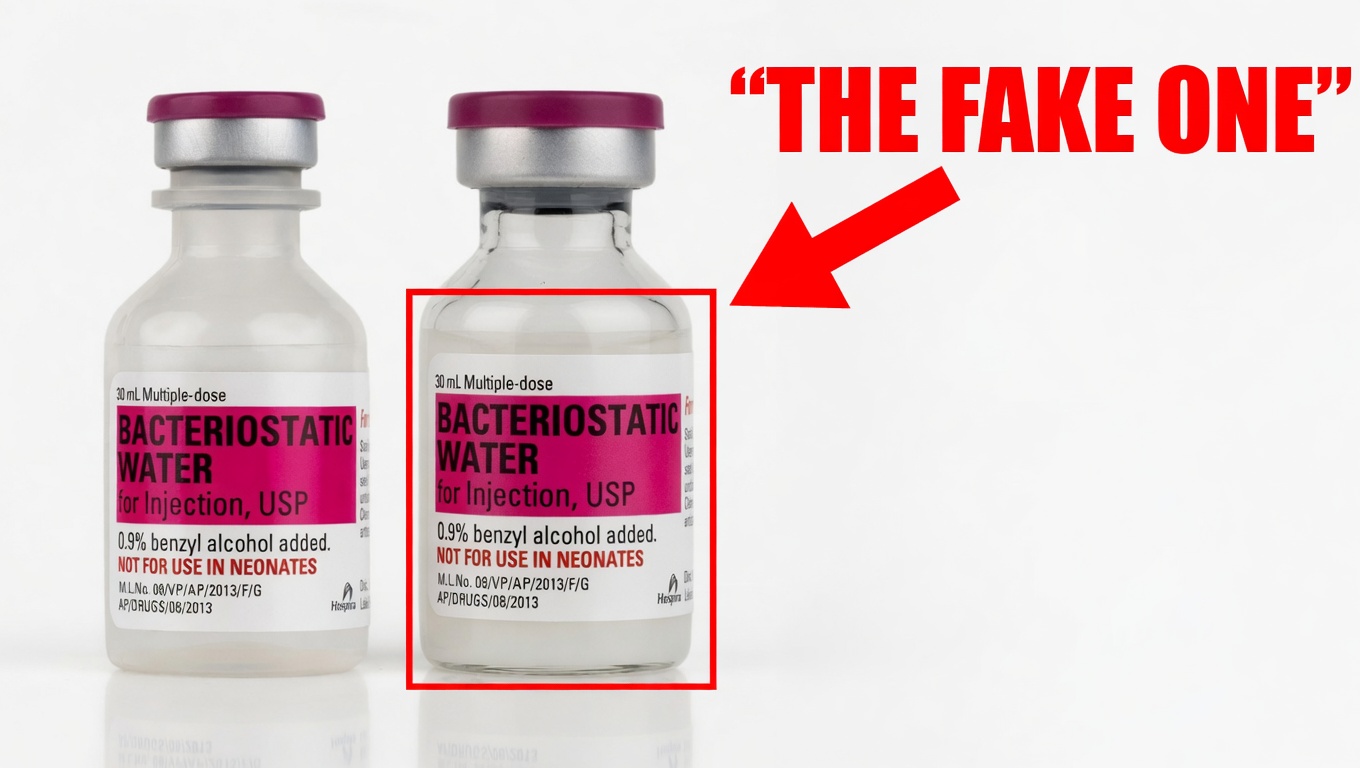
- Manufacturer markings: Authentic Hospira vials carry a clearly printed manufacturer name, NDC number, and lot number. Counterfeits often have blurred, off-center, or smudged printing.
- Flip-off cap: The colored cap on genuine product is printed crisply with manufacturer identification. Generic or blank caps are a warning sign.
- Stopper integrity: The rubber stopper should be flush, undamaged, and show no prior puncture marks.
- Label adhesion: Labels on counterfeits frequently lift at the edges or appear glued rather than heat-sealed.
- Container material: The common 30 mL Hospira multi-dose bacteriostatic water is packaged in a non-pressurized plastic vial/bottle with a flip-top closure — not glass, and not a pressurized aerosol.
Source Checks
- Purchase only from licensed pharmaceutical distributors or research suppliers that can produce a chain of custody.
- Reject product offered through social media, marketplace listings, or unverified resellers — these are the primary channels for repackaged and counterfeit BAC water.
- Cross-check the lot number against the manufacturer's published recall list.
Pre-Use Visual Inspection
Hold the diluent vial against both a dark and a light background under good lighting:
- The water should be completely clear and colorless.
- There should be no visible particulates, fibers, or floaters.
- The vial should not show a meniscus film or oily sheen at the air-water interface.
If anything looks wrong with the diluent, do not use it to reconstitute peptide material. Discard the vial and source a verified replacement.
What to Do If You Suspect a Contaminated Reconstitution
If a peptide solution develops cloudiness, color change, or visible particulates after reconstitution:
- Do not use the solution for quantitative experiments. Concentration, purity, and activity are all suspect.
- Isolate the diluent vial. Retain it for inspection and, if possible, for independent testing (pH, particulate count, microbial culture).
- Document lot numbers for both the peptide and the diluent. If the issue is the diluent, other vials from the same lot are likely affected.
- Reconstitute a fresh peptide aliquot using verified diluent as a control. If the fresh sample is clear, the original diluent is the most likely cause.
- Report suspected counterfeit product to your supplier and, where appropriate, to the FDA MedWatch program.
Sourcing Verified Bacteriostatic Water at Research Peptide Hub
Because diluent quality directly determines reconstitution quality, we stock genuine Hospira (Pfizer) Bacteriostatic Water for Injection, USP alongside our research peptides — sourced through licensed pharmaceutical distribution with verifiable lot traceability.
Every vial we ship is:
- Authentic Hospira manufacture — produced under cGMP, USP-compliant for sterility, particulate matter, and pH
- 0.9% benzyl alcohol preservative at full specification
- Lot- and expiry-controlled — we rotate stock and do not ship near-expiry inventory
- Inspected on receipt — vials with damaged caps, label defects, or compromised seals are pulled before they enter the catalog
- Shipped intact — original sealed packaging, not repackaged or relabeled
Pairing your peptide order with verified diluent removes one of the most common — and most preventable — sources of failed reconstitutions.
We do not sell compounded, repackaged, or "bacteriostatic-style" water. If a supplier offers BAC water at a price that seems too good to be true, or refuses to disclose the manufacturer and lot, that is the supply chain this article is about.
Bacteriostatic water sold by Research Peptide Hub is intended for laboratory and research use only.
Summary
The integrity of a research peptide solution is a product of two inputs: the peptide and the diluent. A certificate of analysis on the peptide is meaningless if the bacteriostatic water used to reconstitute it is uncharacterized. Counterfeit or off-spec BAC water introduces particulates, microbial growth, trace metals, and pH excursions — each of which can manifest as cloudiness, color change, or aggregation in what should be a clear solution.
For reliable research data, source bacteriostatic water from verified manufacturers (Hospira/Pfizer being the standard in the U.S. market), inspect every vial before use, and treat any unexpected cloudiness as a signal to stop and investigate rather than a cosmetic curiosity.
Disclaimer: This article is provided for educational and informational purposes only. All products referenced are intended strictly for laboratory and research use.